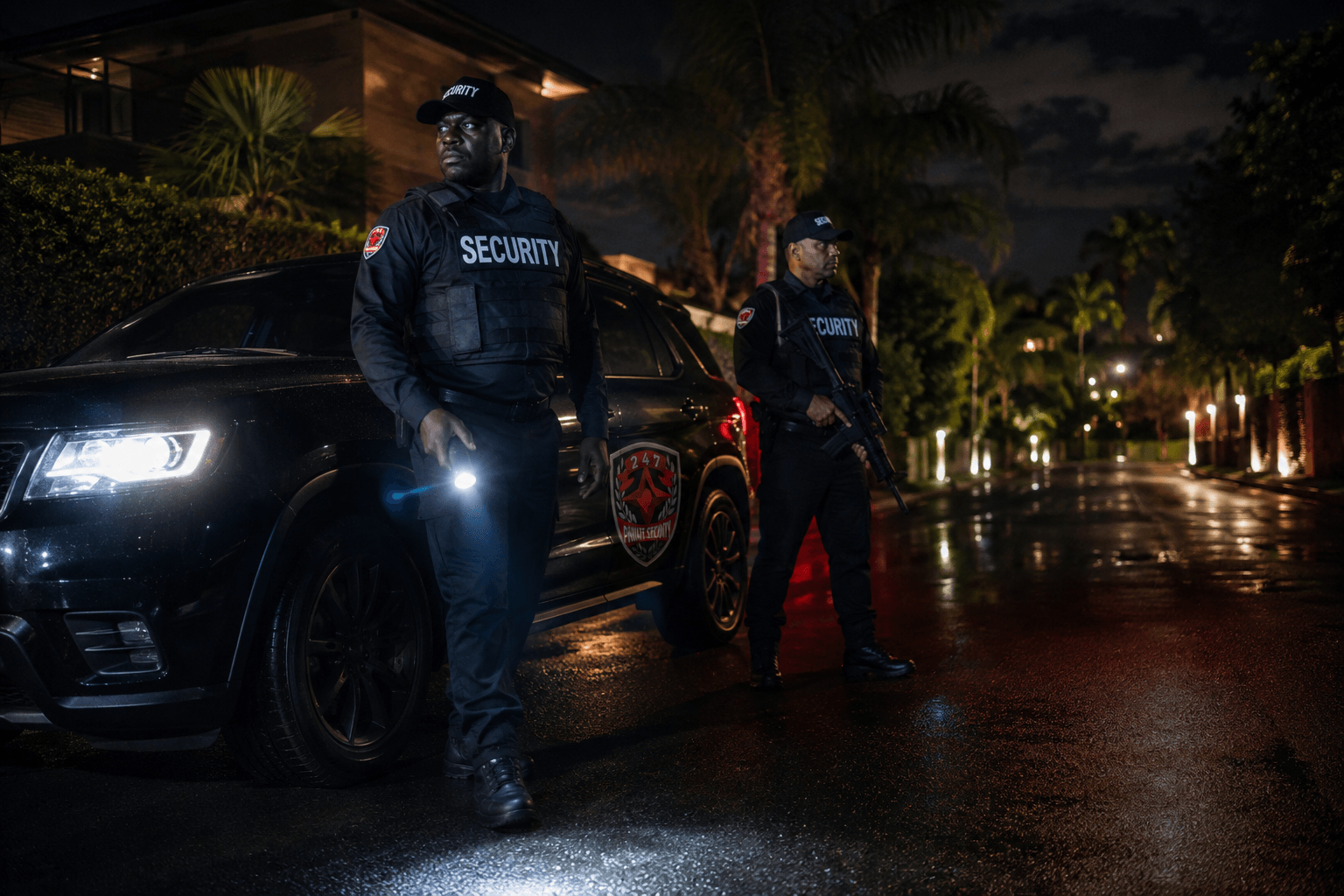
Armed and unarmed patrol covers the two patrol-officer authority levels available under California BSIS licensing — and the operational scenarios where each is the right choice. 247 Private Security deploys both armed and unarmed BSIS-certified officers across Greater Los Angeles for foot patrol, vehicle patrol, mobile alarm response, and combined post-and-patrol coverage. Armed officers hold DOJ-issued exposed-carry firearm permits per California Bureau of Firearms standards. Every patrol scenario is scoped to threat profile, property type, and the specific deterrence requirements.
When armed patrol is the right choice
- Cash-handling sites — dispensary lobbies, bank exteriors, ATM-rich retail areas, cash-business neighborhoods
- High-threat properties — post-incident response after a robbery, burglary, or workplace-violence threat
- High-value asset protection — jewelry stores, designer retail, art galleries, watch and electronics retail
- High-net-worth residences — when explicit threats exist or the family-office security plan requires armed coverage
- Cannabis industry — dispensary lobbies, cultivation sites, distribution centers where DOJ-regulated inventory plus high cash on hand drive robbery risk
- Construction sites with prior theft history — when copper theft, equipment theft, or vandalism patterns have established the site as a target
- Executive protection patrol — when patrol coverage of an executive residence or workplace is paired with EP-style threat profile
When unarmed patrol is the right choice
- General commercial property — Class A office building patrol, mall foot patrol, hospital interior patrol, campus coverage
- HOA and residential community patrol — where the patrol mission is deterrent presence and rule enforcement, not threat response
- School and child-facing environments — schools, daycares, child-services facilities where armed presence is inappropriate
- Healthcare facilities — most medical offices, urgent care, dental offices where the patrol role is patient-flow and access control
- Hospitality and customer-facing retail — where unarmed deterrent presence is more aligned with the customer experience
- Idle construction sites without prior incidents — where deterrent vehicle patrol is sufficient
- Daytime parking enforcement — VC 22658 patrol where threats are minimal and uniformed unarmed presence is sufficient
What armed officers add
- Exposed-carry firearm — visible deterrent against armed criminals; per BSIS regulations, openly visible holstered firearm
- Higher threat-response capability — trained on use-of-force escalation, defensive shooting, lethal-force decision-making
- DOJ certification — Bureau of Firearms exposed-carry permit with annual recertification
- Annual firearm qualification — 14-hour BSIS firearm course with range-qualification scoring
- Extended use-of-force training — beyond standard BSIS guard-card training
- Live Scan FBI/DOJ background re-screened — armed officers undergo more rigorous and recent background verification
What unarmed officers provide
- Visible deterrent presence — uniformed officer presence alone deters most casual and opportunistic threats
- De-escalation primacy — trained to talk-down, document, and call for backup (911 or armed officer) when threats escalate
- Reporting and observation — primary role is observation, documentation, and escalation; not direct armed response
- Lower client liability profile — armed engagements carry higher liability exposure, even when justified
- Wider deployment flexibility — unarmed officers can work in environments where armed presence is inappropriate (schools, healthcare, hospitality)
- Reduced cost — unarmed officers run $8–12/hour less than armed officers
Pricing
- Unarmed foot patrol: $28–34/hour
- Armed foot patrol: $34–42/hour
- Unarmed vehicle patrol per pass: $45–65 per documented pass
- Armed vehicle patrol per pass: $58–82 per documented pass
- Hourly vehicle patrol (exclusive property): $32–38/hour unarmed, $40–50/hour armed
- 24/7 armed patrol coverage: $28,000–$35,000 per month per post
- 24/7 unarmed patrol coverage: $22,000–$28,000 per month per post
Choose the right patrol mode in Los Angeles
247 Private Security is licensed under PPO #120440 through the California Bureau of Security and Investigative Services. Armed officers hold current firearm permits per California DOJ Bureau of Firearms standards. We cover all Greater Los Angeles, Orange County, and Ventura County. Related: armed officers, unarmed officers, patrol overview, foot patrol, vehicle patrol. To set up patrol, submit your property details or call 818-805-4342.